I've been thinking of legacy lately for many different reasons, including the preparation for my upcoming Effortless Memoir class at the Vero Beach Museum of Art on February 26.
There are all sorts of complexities to leaving a personal legacy, and sometimes it seems that the deeper one delves into the issue of what to leave behind the more difficult leaving any meaningful legacy becomes.
But some things about legacy are simple. Including this basic but easy to overlook fact: we all leave the most powerful legacy by not worrying too much about legacy, but rather living intensely and intentionally right now.
Legacy isn't created by hedging one's bets and projecting into the future. It's created by finding something you really love or believe in, and immersing yourself there in the present.
Contemporary American poet and novelist Marge Piercy has a wonderful way of communicating truths that are at once deeply complex and gorgeously simple. Though it is not about legacies only, her poem To Be of Us is all about the immersion that creates lasting ones. "The people I love the best/ jump into work head first/ without dallying in the shadows," she writes therein, adding, "I want to be with people who submerge/ in the task..." The poem concludes:
The work of the world is common as mud.
Botched, it smears the hands, crumbles to dust.
But the thing worth doing well done
has a shape that satisfies, clean and evident.
Greek amphoras for wine or oil,
Hopi vases that held corn, are put in museums
but you know they were made to be used.
The pitcher cries for water to carry
and a person for work that is real.
(To Be of Use copyright Marge Piercy)
I love that phrase, "the pitcher cries for water to carry." As it suggests, we are all in some sense vessels, crying out for meaning to carry and memory or wisdom to share.
Visit Marge Piercy's website to learn more about the writer and her rich, varied and enduring work by
clicking here.
Showing posts with label legacy. Show all posts
Showing posts with label legacy. Show all posts
Friday, February 18, 2011

Monday, February 7, 2011
LIFE STORY WRITING 5: undoing the lessons of the past

Most of us are taught writing in school—with mixed results. Hopefully, we end up with a working knowledge of English and its forms at the end of our schooling. But many of us also leave our years of English classes with less helpful lessons as well.
We learn to expect others to judge the small points of our writing, sometimes quite harshly. We learn to prize organization and logic over feeling and grammatical correctness over expression. We learn to write more easily in response to external pressure than in reaction to our own needs and preferences. We learn to admire "great" writers, but also to discount our own voices.
It's not surprising that as adults, we may find it more comfortable to avoid writing entirely than to take the risk of "failing." If we want to do any creative or legacy writing as adults, we must actually unlearn those lessons. This can be a slow process, and almost always requires some patience.
It may help to think consciously about your readers as you begin to write. Replace the mental image of that high-school teacher who picked on your grammar with a vision of your children, grandchildren, friends, colleagues: whoever it is you feel you are writing for. Seeing those loving faces in your mind's eye will help remind you that these days, there are no grades and no demerits.
To pass this "test," all you need to do is sit down and share a little of your heart.
Thursday, February 3, 2011
LIFE STORY WRITING 3: five simple story starters
Following up on my last post, here are some easy but effective starting points for life story writing. You might want to try a few of these, and then continue on with whichever one or ones feels the easiest and most rich.
With all of these starters, the keys are the same. First, start small. Define your task as completing one paragraph, two paragraphs, or a single page at most, but try to write regularly. Second, don't judge or censor. Your writing doesn't have to be elegant, skilled, or even neat. As I said in my last post, whatever you write will be a treasure to those who come. Finally, be sure to store whatever you have written safely. If you created your text on a computer, back up the files and print a copy out as well.
1. Choose a single photograph from any point in your past and write a really detailed caption for it. Let yourself capture the people, place, and time it depicts in a full paragraph or even two. Place your text in the album or box in which you keep the photo. Tomorrow, consider writing a caption for another picture. As you go on to write about other images, you can stick to a particular time period or theme, or jump around in whatever way feels right.
2. Choose a single recipe you like to cook. (Or, if you're not a cook, a single recipe you like to eat!) Write a paragraph or two about it. Consider describing what you like about it, when and/or from whom you first learned it, when it is or was eaten, what other memories it inspires, what period of your life it reminds you of. Don't worry if your writing strays from the subject of food; the recipe is just a starting point.
3. If you want to write down memories for your children (adult or still young), start small. Choose one child; write down a single great memory of time with him or her. If you enjoy this, add a second memory about that child tomorrow, or move on to a memory about a different child (or sibling, or grandchild). Don't strain to choose an "important" memory; anything that is meaningful to you will be meaningful to that child, however simple or apparently trivial it seems. On the occasion of my fiftieth birthday, my dad wrote a a note to me with the memory of taking naps with me on his chest when I was an infant. I treasure that note all the more because it reminds me of such a small and tender moment.
4. Use place as a starting point for some memory writing. Each day, choose a single place and do some writing about it. The place you choose could be a home, a city, or a vacation spot. It could be as small as a single spot in your yard or house, or as big as your home town. Let your writing roam as it will, whether what comes up are memories of people, pastimes, landscapes...whatever comes up is just fine.
5. Do some writing about the people from your past. For example, you might make a list of five people who influenced you powerfully, then write about one of them each day. At the end of the five day period, decide where to go next. Do you want to write additional material about one or more of those people? Write about five new folks? Move on to a different starting point?
Tuesday, February 1, 2011
LIFE STORY WRITING 2: bigger is not necessarily better

Self-doubt is especially likely when we make a life story writing project too big or too complex. When we bite off more than we can chew, so to speak, we can end up getting mired in the details, losing momentum over time, or feeling unable to meet our own expectations. That's why I link this suggestion to the issue of trust. When we don't trust our potential readers to "get" us or our story, we may feel we need to over-research, over-explain, or over-complicate. We may not even be conscious that we're feeling uncertain or distrustful. Assuming that our kids, grandkids or other readers need lots and lots of information just feels natural...and so does assuming that our life stories won't be meaningful unless they are long or detailed.
I don't mean to prevent you from going into detail or writing at length if those modes feel right for you. Some life story writers genuinely enjoy sinking their teeth into ambitious projects. My point is just that you don't have to produce long or detailed writing to offer a meaningful written legacy.
To prove this point, picture an older relative that has passed on—a grandmother, perhaps. Now imagine that you have just discovered a diary you never knew existed—a journal in which that relative noted down her thoughts. Would you be less grateful for, and fascinated by, that diary if its entries were brief? Would you find it any less valuable if its "author" did not write at length or provide lots of background information? I'm confident that the answers to both questions would be "no." It might inspire you to find out more or even do some research. It might even make you wish its owner had written more. But the diary would be a treasure whether it was short or long, expansive or succinct. And what you would remember about it over the years wouldn't be its length or detail or historical accuracy, but rather the glimpse it gave you of your relative's heart.
Have I convinced you? I hope so. Check out my next post for some "life story starters" that can help you record memory or family material effectively and easily.
Monday, January 31, 2011
LIFE STORY WRITING 1: begin with trust
I recently wrapped up a class called "Life Story Starters" for the LifeLong Learning Institute at the Indian River State College. (I'm giving a one-day variant on this same class, this time called Effortless Memoir, at the Vero Beach Museum of Art in late February; it's alphabetized under W for Workshops here). This series of posts is inspired by those classes, the peer students it's my privilege to serve within them, and the idea of leaving one's life stories as part of a personal legacy.
All of the lively and intelligent participants in the class wanted to write memory material. As always in such classes, many admitted to doubts about the value of their memories or the quality of their writing. I have complete empathy for anyone with these concerns. After many years as a professional writer, I still often doubt that what I am writing will be of interest to readers, even those in my own family. Especially in the middle of the process, the text I'm creating always feels like a formless mess with no redeeming value.
Yet I also know that when we let such doubts silence us, we withhold a genuine gift from the world. Every life story has value, whether one person reads it or one million. Every personal history witnesses the human condition, and the life of joy and struggle that all of us share in a myriad of different ways.
A funny thing happens in my life story classes after the participants share their self-doubt. The same folks who question their own pieces are rapt in listening to others. Always, without exception, the assignments we read aloud get nods of recognition. Always, the only pieces anyone doubts are their own.
Let’s remember that all of us doubt the value of our thoughts and the skill of our writing. Let’s laugh at our fears and write our reflections down anyway. Let's trust ourselves, and others, enough to share our life legacies generously.
There are enough times in our lives when we need to keep silent, even situations when we need not to speak our truth. This, happily, is not one of them.
Saturday, October 9, 2010
MYSTERIOUS ALBUMS, unknown lives
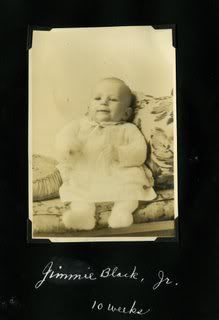
My photo-expert pal CJ scanned the images and also some of the actual pages for a project we did several years ago; I've added one of those scans to this post. As it shows, this photo-owner did caption her photos, and in a graceful handwriting few of us today can match. I've sometimes said that I'm going to do a web search and see if I can find the descendents of some of the names in the book. So far, though, I haven't done much more than browse the album, use some of the pictures in art and blog posts, and simply enjoy it all.
And that enjoyment is the paradox of my ownership of this piece of ephemera. The family pictured in the album might not have valued it, or perhaps they just didn't know it was there for the asking. But I, a complete stranger, love it. I remember its dogs, its houses, its trips to beaches and lakeside cabins. To me it is precious in part because of its mystery. It isn't my family; it's the human family. Maybe that's why I never quite get around to searching for the families it pictures. Maybe it reverberates all the more because of what it doesn't say.
Friday, October 8, 2010
CJ SAYS: "envision seven generations"
CJ reminds us that once we're gone, the information and stories we take for granted in our own lives will be as unknowable to those seven generations in the future as peoples' lives seven generations ago are to us today. We assume that no one really cares, but that's just not the case. Her words spoke to me powerfully because as I organize my parents' photo collection, I'm beset with exactly the kind of bafflement she describes. Where was this picture of my great-grandparents taken? What is the name of the best man at Mom and Dad's wedding? Is this Victorian baby photo my grandmother or someone else--and if it's a grandmother, which one? When exactly did dad's family come to this country?
I don't know the answers to any of those questions, or to countless others like them, and I dearly wish I did. I feel a kind of grief when I realize that I didn't take advantage of the countless years I had to ask some of these questions;
One of the things CJ's post inspired me to do is deceptively simple: to caption the back of my own photos with things like the names of the people pictured, the place the picture was taken, and the approximate date. I've promised myself not to get perfectionistic, just to get down what I know. It's tempting to think that no one will care that one photo is of my college dorm room junior year and the next is of my off-campus apartment senior year, that this guy is my first boss and this other guy is the man I loved in my thirties. But as CJ reminded me, I can't know that for sure...and better safe than sorry.
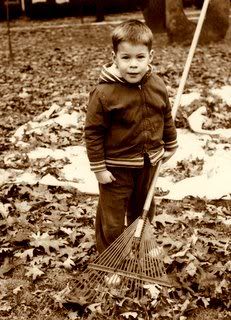
In the spirit of this post, I'll close by telling you that the photo at its beginning is of my twin brother Andy on the lawn of our family house in Caldwell, New Jersey in 1960 or thereabouts. The front yard had thirteen majestic old trees that offered both delight (jumping in giant leaf piles) and torture (helping Mom and Dad rake) every autumn. Our property had a wall that raised it above the street by eight feet or so in the front; the white shape you can see on the ground under the leaves is a big old canvas dropcloth. In the days before day finally got a leaf blower, we raked the leaves onto it, dumped it over the wall, and raked the leaves into the gutter for pickup from there. Andy and I had small, child-friendly rakes, so maybe Dad posed him with a full-scale one for this shot. Either way, I've always loved this particular photo of Andy, with its combination of solidity and skepticism. "You've got to be kidding me," his expression seems to say; "this job's going on forever."
Wednesday, October 6, 2010
PHOTOS, in and out of sorts
At long last and after much creating, shuffling, stacking, and moving of photo piles, I finished getting my family photos into some kind of order this past weekend.
It's satisfying to see the results: a nice-sized box of original photos waiting to be given to my sister and brother, a rough pick of shots to use in the photo books CJ Madigan is making for me through her newly-under-development Snapshot Stories book creation product, and three neat boxes of photos to keep here. One of the benefits (aside from the general pleasure of neatness) is that I can actually enjoy the pictures now, rather than having to rummage around searching when I wanted to use or look at one.
I don't usually mention products, but I must say that the Creative Memories PowerSort photo boxes I used for this project were a nearly perfect solution both for the sorting process and now for my storage needs. I have no relationship with Creative Memories, so I don't mention this with any agenda; I just love it when folks come up with truly useful and ingenious solutions for problems, and appreciate a product that does exactly what it says it does and more. The large versions each hold a whopping 1,200 photos in durable, waterproof, portable and photo-safe fashion (photo safety is important to everyone, but portability and waterproofing are especially crucial to those of us who live in hurricane zones). The twelve mini-containers that can go into and out of each box helped me break down the collection by groups (photos of mom, photos of dad, photos of them together, etc., etc.) and made the sorting much easier than it would have been without them. They're not cheap, but they're immensely more useful than the ordinary little photoboxes I tried to use before.
Having finally gotten everything collected in one place, I was shocked to see that I had over three thousand actual hard-copy photos even after I'd made big boxes for my siblings. That number seemed ludicrously large until I thought about it. I took several hundred shots on every one of my major vacations; each family Christmas probably contributed another fifty or more, each new neice and newphew were good for several hundred over the years...the list goes on and on. When I thought about it this way, I was actually surprised that I didn't have more photos.
Digital photography will reduce these numbers for generations to come; they'll be able to store images on disk rather than having each and every picture developed and printed. I'd like to think that will make their lives easier when it comes to family photos. But then I remember how much most of us struggle to keep our data backed up and deal with computer meltdowns, as well as how many more images most of us take now that we're digital...and I think that it'll be just as hard for them, just in a different way.
Monday, July 26, 2010
FINAL WORDS: a Japanese tradition
The Japanese, who have traditionally looked at death very differently than we do here in the West, have a very old poetic form called jisei: the death poem. Usually written right on the verge of dying, jisei are in some sense a farewell to life and consciousness: the spiritual counterparts of the making of a last will, an important tradition in Japanese culture. Samurai wrote jisei, as did lovers who committed double suicide and people in a variety of other fields. But many of the surviving jisei we have today were written by Japanese monks, and their names, ages, and dates of death are recorded along with their poems. In the process the poems become the monks' legacies, lasting long after their lives, always quietly lived, have ended and passed into history.
The practice of writing a poem right during the act of dying sounds morbid, doesn't it, and also pretty strange? I can't imagine anyone here in the West consciously trying to time their death simultaneously with a poem, though perhaps we should try it. One jisei story tells of a man so preoccupied with making sure that his death poem was appropriate that he began writing examples when he was fifty, a full thirty years or more before he actually died. Maybe the challenge inherent in the project gave him what we would call a longer lease on life.
There is something moving about many jisei pieces, which are mostly in the haiku or tanka form. Some are haunting: A journey of no return:/ the wanderer's sack is/bottomless, wrote a monk named Kyoshu just before his death in 1769. The surface/ of the water mirrors/ many things, another monk wrote in 1825; still another, Boarding the boat/ I slip off my shoes:/moon in the water. Even in the awkwardness of translation, which can never hope to capture either the rhythm of the originals or their complexity of their imagery, they are hauntingly lovely.
But some jisei are wry and earthy. My only hope against/ the cold/one hot-water bottle, wrote Meisetsu; monk Raishi writes, You've done your duty/ till today,/ old scarecrow. A brother named Shiyo, who died at only 32, was downright sardonic--forgiveable, perhaps, in such a young man: Surely there's a teahouse/ with a view of plum trees/ on Death Mountain, too. Utsu, who died in cherry-blossom season, used it for inspiration. The owner of the cherry blossoms/ turns to compost/ for the trees, he wrote.
Whether they are sad or sardonic, jisei always seem to accept—or even embrace—death as a natural part of life rather than just an abrupt or unfair ending to it. That's a hard place for most of us to reach, but jisei let us spend a small, resonant moment there.
The poems quoted above, and many more, can be found in Yoel Hoffmann's lovely collection Japanese Death Poems: Written by Zen Monks and Haiku Poets on the Verge of Death.
Monday, July 19, 2010
A PERFECT LITTLE FILM ON THE PASSAGE OF TIME
Though it uses no fancy techniques and makes no startling statements, this little film on the passing of time is a quiet gem. If you have children or grandchildren, it will surely speak to you; but if you don't, it will probably speak to you anyway. It is from Gretchen Rubin, the author of the New York Times bestseller The Happiness Project.

Tuesday, June 22, 2010
BIG PICTURE, SMALL LENS
Photographer Jeannette Montgomery Barron's little book My Mother's Clothes: An Album of Memories  recently reminded me that we sometimes create the most vivid memorials to those we've loved and lost when we give ourselves permission to to notice small things rather than stretch for big meaning.
(If you follow my Working Writer Wonders blog, you will remember a recent post about the same book, in a different context.)
In her prime, Barron's mother Ellie was what we once called a clothes horse, a woman who loved exquisite garments and owned a lot of them. Later in life, as her memory began to fail, her daughter began to photograph her clothes to help spark recollections. The images in the book--of dresses and stockings, purses and bathing caps, hangers and size labels--thus have a double resonance. The project may have begun as an aid to the mother's memory, but in the end it also became a way to sustain the daughter's.
There are only a very few pages of photographs of Eleanor herself, and they come right at the very end of the book. But the simplicity of the still life photos and the very brief text Barron wrote to accompany each such a rich, specific picture that I barely noticed their absence. I felt Ellie's presence. I felt the pain of the absences her Alzheimer's and then her death created. I felt that in some way I knew Barron herself as well, knew some of the ways her personality was shaped in response to her mother's.
Barron makes no grand claims for her mother or her book, describes few of the details in a traditional biography, and offers few if any grand words about "big" concepts like values, legacy, or the meaning of life and death. Maybe that exactly why her lovely little work speaks so clearly...because it pays such quiet and devoted attention to the small choices that, in the end, comprise a life.
My own mom's personal style was completely different from that of Barron's mom, yet the book sparked so many of my own memories. If you're a daughter like me, I bet it will do the same for you whether your mother is living or not. Her web site is worth a visit, too; click here to visit the page where she talks about the book and its inspiration.
recently reminded me that we sometimes create the most vivid memorials to those we've loved and lost when we give ourselves permission to to notice small things rather than stretch for big meaning.(If you follow my Working Writer Wonders blog, you will remember a recent post about the same book, in a different context.)
In her prime, Barron's mother Ellie was what we once called a clothes horse, a woman who loved exquisite garments and owned a lot of them. Later in life, as her memory began to fail, her daughter began to photograph her clothes to help spark recollections. The images in the book--of dresses and stockings, purses and bathing caps, hangers and size labels--thus have a double resonance. The project may have begun as an aid to the mother's memory, but in the end it also became a way to sustain the daughter's.
There are only a very few pages of photographs of Eleanor herself, and they come right at the very end of the book. But the simplicity of the still life photos and the very brief text Barron wrote to accompany each such a rich, specific picture that I barely noticed their absence. I felt Ellie's presence. I felt the pain of the absences her Alzheimer's and then her death created. I felt that in some way I knew Barron herself as well, knew some of the ways her personality was shaped in response to her mother's.
Barron makes no grand claims for her mother or her book, describes few of the details in a traditional biography, and offers few if any grand words about "big" concepts like values, legacy, or the meaning of life and death. Maybe that exactly why her lovely little work speaks so clearly...because it pays such quiet and devoted attention to the small choices that, in the end, comprise a life.
My own mom's personal style was completely different from that of Barron's mom, yet the book sparked so many of my own memories. If you're a daughter like me, I bet it will do the same for you whether your mother is living or not. Her web site is worth a visit, too; click here to visit the page where she talks about the book and its inspiration.
Saturday, June 12, 2010
LETTING GO FOR THE GREATER GOOD
Like most people, I have found it hard to let go of my late parents' things. My head is absolutely certain that they would not for a minute want me to turn my home into a museum of their every possession (as well, for that matter, of my grandparents' things, which they inherited and passed down in their turn). But my heart doesn't buy it. No matter how trivial the item or how little my parents themselves cared about it, it just feel unloving to give it away.
Over time I have found three things that make this easier, though never easy. The first is practice. The second a digital photograph, a strategy I'll write about in another post. The third is a strategy I've come to think of as "letting go for the greater good"--an overly grandiose name, really, but the best I can do.
Letting go for the greater good just means finding a way to honor some possession, and with it my parents' legacies, more in the giving-away of it than in the holding on. When I make the gift, its purpose, and its effect significant somehow, I feel not just comfortable but even good about letting the object go.
My siblings and I did this with the furniture none of us could fit from my parents' home. We gave those extra pieces, many of which were lovely and all of which were practical, to a young woman who had been living in the SafeSpace shelter and was now moving hereslf and her two kids to a new apartment. There could be no doubt, seeing the joy in her face, that giving these things away was much more meaningful than stuffing them somewhere in our own houses. Indeed, I could feel my mother's joy that the table, for example, that she had served so many loving family meals on would now be helping to make such gatherings possible for another mom who had been left with virtually nothing.
My dad's golf clubs were another sticking point. He dearly loved the game, and his bag and all of its accoutrements were just about impossible for me to let go. Until, at least, a friend had his own clubs stolen recently, right in the midst of a year of other financial challenges. How lovely it felt to give him Dad's gear and with it, a temporary substitute he could use until he had the time or money to replace the stolen clubs. I know Dad would approve. My friend promised to donate any clubs he didn't keep to First Tee, and I promised him that none of Dad's eternal putting "yips" were being passed on with his putter.
I guess all I'm saying, at rather great length, is that it's helpful to remember that hanging onto something may not turn out to be the best way we can honor a loved one's memory. Honoring their spirit, their values, their joys is so much more important than keeping a dining-room chair or a nine-iron. At least, that's the way I'd like to be remembered, and I think my parents would agree.
Subscribe to:
Posts (Atom)


