THE GRIEFGLOW MANIFESTO: WHY THIS BLOG?

This blog finds its roots in the losses of my life and my slow, stumbling, but steady path towards healing. Of all the resources I explored when I was newly bereaved and deep in grief, the most powerful ones were those that simply shared someone else's story. The least helpful were those that either tried to fix or change me, or communicated with such mutedness and sadness they seemed to make my own sadness worse. In reacting to such times, I came up with something I called the GriefGlow manifesto, which goes as follows. I am pleased to share it and some glimpses of my journey with you. So, the GriefGlow Manifesto: Because grief is never black and white. Because healing is hard enough without coloring everything around us gray. Because we're just sad, not broken. Because we are a community, even when we feel the most alone. Because a picture is worth a thousand words when we have no words to say. Because we don't need to be changed, fixed, taught, or hurried. Because being vulnerable isn't the same as being powerless. Because our story isn't over. Because the world is as beautiful as it is painful. And because though a little bit of beauty can't change the pain today, it may help us toward healing tomorrow.


Sunday, January 2, 2011

EBB AND FLOW: apologies and a new year's greeting

When I opened up this blog today I was shocked to see that I had not posted here since October. How could more than two months have passed? Where have I been?

I'm not exactly sure.

I think that's why it was so hard to blog. Everything seemed unclear there for a while. I found myself revisiting all sorts of actions and feelings from the past, looking at them in a new way. I felt the grief for my late parents again, or perhaps I should say I felt a new sense of loss for and celebration of them for the first time. I revisited the way my home was arranged, and moved most of the things in it until it felt more authentic to the way I feel and live now. I sold some things I had owned for decades, and donated many more. I revisited the issue of my writing, which again got pushed rather onto the back burner during the year, and the related issue of my teaching and consulting business.

Several times during the process I had flashes of memory from my childhood days on the beach. The motion of the waves fascinated me. And the complex, moody play of colors. The endless changes and movements. The way the water moved the things in its path. Some of the round, heavy pebbles of that northern beach seemed barely jostled by each new wave, but as I stood there, rooted and watching, they did move, sometimes quite far.

That's probably why I remembered those beachside experiences during this time. They seemed a newly apt metaphor for the place where I find myself. Little in my life seems to have changed, and at times I feel that I have made little progress. And yet even the heaviest of the stones move if I wait long enough, and muster enough patience for the slow, eddying work of time.

From my place in the ebbing and flowing of life, I send a New Year's Greeting to all of you out there, and wish that you will have a deep and fluid twenty-eleven. You will find me posting here again, now that I know once more where I am. I am here on the beach, honing my capacity to muster the grace and patience to let the rocks move.

Saturday, October 9, 2010

MYSTERIOUS ALBUMS, unknown lives

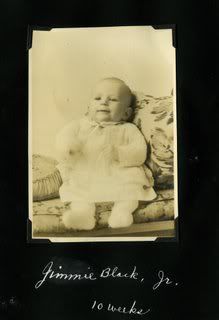
My recent posts on my own family photos reminded me of a vintage photo album I bought in a thrift shop a decade or so back. I loved the "period" look of it--the black pages annotated with white ink, the traditional photo corners, the textured cover. I was amazed to see that virtually all of its several hundred photos were intact. And yes, being the sentimental crazy woman I am, I was saddened by it. Here was the history of an entire personal and family life, lovingly created, a small treasure but one that is both complex and precious...left to languish on a shelf with a ten dollar price tag. Naturally, I could do nothing other but scoop it up for "adoption."

My photo-expert pal CJ scanned the images and also some of the actual pages for a project we did several years ago; I've added one of those scans to this post. As it shows, this photo-owner did caption her photos, and in a graceful handwriting few of us today can match. I've sometimes said that I'm going to do a web search and see if I can find the descendents of some of the names in the book. So far, though, I haven't done much more than browse the album, use some of the pictures in art and blog posts, and simply enjoy it all.

And that enjoyment is the paradox of my ownership of this piece of ephemera. The family pictured in the album might not have valued it, or perhaps they just didn't know it was there for the asking. But I, a complete stranger, love it. I remember its dogs, its houses, its trips to beaches and lakeside cabins. To me it is precious in part because of its mystery. It isn't my family; it's the human family. Maybe that's why I never quite get around to searching for the families it pictures. Maybe it reverberates all the more because of what it doesn't say.

Friday, October 8, 2010

CJ SAYS: "envision seven generations"

When I turned on my computer I found book designer, systems genius and just-plain-interesting-thinker CJ Madigan's new blog post, "Envisioning Seven Generations," in my email inbox. If you're interested in legacy or personal stories, it's one to read (just click on its title and the link will get you to it).

CJ reminds us that once we're gone, the information and stories we take for granted in our own lives will be as unknowable to those seven generations in the future as peoples' lives seven generations ago are to us today. We assume that no one really cares, but that's just not the case. Her words spoke to me powerfully because as I organize my parents' photo collection, I'm beset with exactly the kind of bafflement she describes. Where was this picture of my great-grandparents taken? What is the name of the best man at Mom and Dad's wedding? Is this Victorian baby photo my grandmother or someone else--and if it's a grandmother, which one? When exactly did dad's family come to this country?

I don't know the answers to any of those questions, or to countless others like them, and I dearly wish I did. I feel a kind of grief when I realize that I didn't take advantage of the countless years I had to ask some of these questions;

One of the things CJ's post inspired me to do is deceptively simple: to caption the back of my own photos with things like the names of the people pictured, the place the picture was taken, and the approximate date. I've promised myself not to get perfectionistic, just to get down what I know. It's tempting to think that no one will care that one photo is of my college dorm room junior year and the next is of my off-campus apartment senior year, that this guy is my first boss and this other guy is the man I loved in my thirties. But as CJ reminded me, I can't know that for sure...and better safe than sorry.

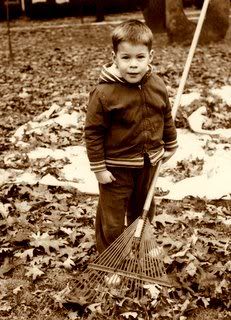
In the spirit of this post, I'll close by telling you that the photo at its beginning is of my twin brother Andy on the lawn of our family house in Caldwell, New Jersey in 1960 or thereabouts. The front yard had thirteen majestic old trees that offered both delight (jumping in giant leaf piles) and torture (helping Mom and Dad rake) every autumn. Our property had a wall that raised it above the street by eight feet or so in the front; the white shape you can see on the ground under the leaves is a big old canvas dropcloth. In the days before day finally got a leaf blower, we raked the leaves onto it, dumped it over the wall, and raked the leaves into the gutter for pickup from there. Andy and I had small, child-friendly rakes, so maybe Dad posed him with a full-scale one for this shot. Either way, I've always loved this particular photo of Andy, with its combination of solidity and skepticism. "You've got to be kidding me," his expression seems to say; "this job's going on forever."

Wednesday, October 6, 2010

PHOTOS, in and out of sorts

At long last and after much creating, shuffling, stacking, and moving of photo piles, I finished getting my family photos into some kind of order this past weekend.

It's satisfying to see the results: a nice-sized box of original photos waiting to be given to my sister and brother, a rough pick of shots to use in the photo books CJ Madigan is making for me through her newly-under-development Snapshot Stories book creation product, and three neat boxes of photos to keep here. One of the benefits (aside from the general pleasure of neatness) is that I can actually enjoy the pictures now, rather than having to rummage around searching when I wanted to use or look at one.

I don't usually mention products, but I must say that the Creative Memories PowerSort photo boxes I used for this project were a nearly perfect solution both for the sorting process and now for my storage needs. I have no relationship with Creative Memories, so I don't mention this with any agenda; I just love it when folks come up with truly useful and ingenious solutions for problems, and appreciate a product that does exactly what it says it does and more. The large versions each hold a whopping 1,200 photos in durable, waterproof, portable and photo-safe fashion (photo safety is important to everyone, but portability and waterproofing are especially crucial to those of us who live in hurricane zones). The twelve mini-containers that can go into and out of each box helped me break down the collection by groups (photos of mom, photos of dad, photos of them together, etc., etc.) and made the sorting much easier than it would have been without them. They're not cheap, but they're immensely more useful than the ordinary little photoboxes I tried to use before.

Having finally gotten everything collected in one place, I was shocked to see that I had over three thousand actual hard-copy photos even after I'd made big boxes for my siblings. That number seemed ludicrously large until I thought about it. I took several hundred shots on every one of my major vacations; each family Christmas probably contributed another fifty or more, each new neice and newphew were good for several hundred over the years...the list goes on and on. When I thought about it this way, I was actually surprised that I didn't have more photos.

Digital photography will reduce these numbers for generations to come; they'll be able to store images on disk rather than having each and every picture developed and printed. I'd like to think that will make their lives easier when it comes to family photos. But then I remember how much most of us struggle to keep our data backed up and deal with computer meltdowns, as well as how many more images most of us take now that we're digital...and I think that it'll be just as hard for them, just in a different way.

Wednesday, September 8, 2010

PHOTOGRAPHS, past and present

To give myself some respite from the computer, I spent some of Labor Day weekend sorting through photographs of my late mom and dad. My friend and colleague CJ Madigan is going to create small books from them using her new Snapshot Stories format (I'm a test subject; watch her web site for its introduction later this fall, and this blog for a peek at my books when completed.)

Looking through old photos is a mixed blessing once you've lost close loved ones. The sight of their faces in a picture is bittersweet, reminding you that they are no longer here yet at the same time recalling happy times together. My own photo "shoebox" had scores of wonderful shots, an abundance that made choosing among them difficult.

Today, most everyone has that same kind of overstuffed shoebox (or album, or drawer). The most obvious reason for this is that these days anyone can take a photo, from almost any kind of device from the most elaborate camera to the simplest cell phone. Anyone can print that photo, too, at least anyone who has access to a drugstore photo lab or a home computer. How different this is from my childhood, when developing a negative required both expertise and a special room full of expensive equipment, much less from the early days of photography when the camera, too, was expensive and difficult to use.

But it's not just technical issues that allow us to take photographs for granted today. We also enjoy long life expectancies and relatively easy, relatively affordable travel. It's fairly easy, most of the time at least, to see the people we have photographs of. The exact opposite was true in the early days of photography. Travel was dangerous and expensive; families that were separated might not see each other for years, if ever. Death was an everyday fact of life, taking away everyone from infants to children to mothers and on. The rich could afford portraits of those from whom either death or other circumstance had separated them, but others could not.

And so a photograph was not just a pleasure, but a prize. Here is Jane Welsh Carlyle, the wife of celebrated author and intellectual Thomas Carlyle, writing on the subject in 1860: "Blessed be the inventor of photography! I set him above even the inventor of chloroform! It has given more positive pleasure to poor suffering humanity than anything else that has cast up in my time or is like to—this art by which even the poor can possess themselves of tolerable likenesses of their absent dear ones."

That reference to chloroform is worth noting; it wasn't one that was made lightly. Ether and chloroform, the first general anesthetics, were still relatively new in 1860 (Queen Victoria, for example, had not used one until the birth of her eighth child in 1853). To set photography above chloroform, a substance that relieved horrendous labor or surgical pain, was to praise it highly indeed.

So while culling down my pile of "possible" photos was a chore, I tried not to forget that it was also a privilege. We are indeed lucky today, not just to have the luxury of easy photography (and easy book-making services like CJ's) but also to have the blessing of the long and healthy lives that let us enjoy each other in person.

Tuesday, September 7, 2010

ONE CLASSIC, TWO WAYS

Mary Elizabeth Frye's poem Do not stand at my grave and weep is one of the world's best known poems on death and grief, having been translated and adapted to music across the world since its creation in 1932.

This isn't great poetry per se; it doesn't have the emotional or linguisitc depth of great writers on loss like John Donne or Dylan Thomas. Yet it's a powerful poem nonetheless, precisely because of that simplicity. It's timeless, and in some way place-less too, meaningful to anyone who has ever looked at nature. To me, in fact, it reads more like hymn lyrics than like a modern lyric poem. In addition to the printed version, I've given you a version of the poem sung by Welsh classical crossover artist Katherine Jenkins on her Living A Dream CD. I don't always like the result when poems are set to music; often, the language alone is more effective. But because this poem is so simple in its cadences and hymn-like in its diction, it seems to fit naturally with melody, and just as naturally with Jenkin's classical voice. 

Do Not Stand at my Grave and Weep

Do not stand at my grave and weep.
I am not there, I do not sleep.
I am in a thousand winds that blow,
I am the softly falling snow.
I am the gentle showers of rain,
I am the fields of ripening grain.
I am in the morning hush,
I am in the graceful rush
Of beautiful birds in circling flight,
I am the starshine of the night.
I am in the flowers that bloom,
I am in a quiet room.
I am in the birds that sing,
I am in each lovely thing.
Do not stand at my grave and cry,
I am not there. I did not die.

Sunday, August 15, 2010

JOANNA TROLLOPE ON LOVE AND LOSS

Passionate Man: A NovelBritish writer Joanna Trollope writes family, love and change with warmth, delicacy, and a wise understanding of the complexities of modern lives. Two of Trollope's novels, Next of Kin and A Passionate Man, deal explicitly with themes of loss and grief. A Passionate Man, my favorite of the two, begins when its protagonist Archie Logan learns that his father, who for many years has been a widower, has begun a passionate relationship with a charming older woman. Archie is an adult with a busy, successful life, but his father's sudden transformation from parent and best friend to besotted man in love jolts him back into childlike feelings of loss, jealousy and doubt. As he struggles to accept this new perspective on his father, he begins to question himself, his marriage and career as well—questions that remain far from resolved when his father suddenly passes on. The lives and personalities in the story are rich and messy, just as in real life, and the ending is happy without being in any way glib, simplistic or pat. I suppose that's the thing that I liked best about the book: Trollope's ability to write about the way change is inevitable in human lives, as well as the way we all grieve, heal, and move on.

Tuesday, August 3, 2010

OPTIMISM: poet Jane Hirshfield on true resilience

I read this poem by the gifted American contemporary poet Jane Hirshfield for the first time just recently, and it really spoke to me. I especially love the qualifier,  "Not the simple resistance of a pillow, whose foam/ returns over and over to the same shape..." How aptly that describes the unthinking, unchanging optimism many of us have early in life...and how lyrically the remainder of the work evokes the deeper resilience that comes with time, experience, and pain.

Optimism

More and more I have come to admire resilience.

Not the simple resistance of a pillow, whose foam
returns over and over to the same shape, but the sinuous
tenacity of a tree: finding the light newly blocked on one side,
it turns in another. A blind intelligence, true.
But out of such persistence arose turtles, rivers,
mitochondria, figs–all this resinous, unretractable earth.

Most definitely, a poet worth reading.

"Optimism" is by Jane Hirshfield and appears in Given Sugar, Given Salt, © Harper Collins, 2002.This link to the archives of Poetry magazine gives you a brief biography of the poet and several of her other beautifully written poems; this one brings you to the agency that books her for speaking and readers, which offers a longer biography.

Wednesday, July 28, 2010

LOSSES AND SPRING LEAVES

I love this photograph of a cemetery monument jostled by new foliage. It's beautiful, and it "says" something true in a slightly impish way.

The true part is that our losses from the past and the new growth of the future coexist, side by side. We may not see the growth part when we are suffering the early stages of bereavement, but it's there somewhere, waiting. Waiting to nudge us with its exuberance. Waiting to give the world around us color and freshness and purpose again. Waiting to prove to us that no matter how stony our soil feels, new life will grow there.

The impish part is that new life won't always arrive in dignified ways. Sometimes it pops up right in our face, just forcing us to take notice.

Monday, July 26, 2010

CAREGIVING'S DECLUTTERING, AND BACK

Writer and ecologist Susan J. Tweit's Walking Nature Home blog is subtitled "living a green and generous life," and those two "g words" describe it perfectly. (She is also the author of a memoir of the same name, published by the University of Texas Press in 2009, among other books and texts.) Browsing the blog's rich writings, I came across an older post that spoke directly to my heart, and I think may speak to you as well if you have walked the journey of a caregiver. One of the subjects treated in the blog is the journey of Tweit's husband, Richard Cabe, through treatment for brain cancer. On January 24 of this year, she wrote:
Since Richard and I moved home from our sojourn in the land of brain cancer radiation treatment—has it only been a week and a half?—I've been struggling to regain a healthy working rhythm. While we were away, life was simpler in some ways. My main focus was caring for Richard and helping him stay as healthy as possible—physically, mentally, emotionally and spiritually. Beyond that, my energy went into taking care of me, which means doing yoga every day, taking walks, and writing the words of my heart and spirit. I had left the to-do list, the obligations, the everyday worries at home. It wasn't hard to stay grounded and steady.
In the transition back home though, I somehow lost that cancer-cloister serenity. My life is suddenly cluttered by worries and obligations and to-dos. I worry about money. (Back to the real world.) I'm overwhelmed by trying to balance work, house, husband, and community. My to-do list seems endless: writing assignments, consulting, workshops to plan, a keynote speech coming up, presentations, schedules, bills, the house, yard and garden, friends, family....
This morning though, as I purged and dusted and organized my work space, I felt myself settle. With the clutter cleared away, I could see anew the life and work I've built in the treasures I've surrounded myself with...[read the rest of the post here]

I, too, felt that paradox: that when I was most deeply engaged in the rich, demanding service of caring for and with a sick loved one, the convoluted triviality of everyday life seemed to recede almost entirely from my consciousness. On one level, cancer and chemo are so profoundly and painfully complex; in another sense, I realized during this time, they are completely stark and simple. In a cancer center or "sickroom," a hospice or hospital, our priorities are clear. And then we comes back to home ground, to the to-do list and complications and blur that Tweit writes about so gracefully. Like her, the only way I could get my focus back was to treat the house I returned to as somehow new, polishing and emptying it so that I could reconnect with it and myself. I even asked a dear friend if she'd help me create some kind of "returning home ritual"; she brought nurturing food and fragrant sage, and we smudged the house to help renew its spirit as well as my scattered, disoriented energy.

Let's not be surprised if we can't quite connect with what is familiar or ordinary when we return from the deep spaces of planning and coordinating and giving care. Those spaces are worlds of their own, and it makes sense that we'd need to do some literal and metaphorical housecleaning in order to feel at home once more.